AI Breaking Cryptography? Cryptography Is Human-Designed, and Mathematical Discovery Is Not the Singularity

An Epistemic Analysis of Mathematical Reasoning, Cryptographic Security, and Unsafe Commitment through PIB, FCL, and FCL-S
Hiroko Konishi
AI Researcher
Synthesis Intelligence Laboratory, Japan
ORCID: 0009-0008-1363-1190
November 26, 2026
Abstract
Recent reports suggesting that artificial intelligence may have achieved a major breakthrough in cryptography raise a fundamental epistemic question: does a mathematical discovery necessarily imply practical cryptographic capability, let alone the emergence of a technological singularity?
Cryptographic systems are human-designed technological constructs built upon mathematical properties and computational assumptions. Their security depends on specific conditions rather than being guaranteed by immutable natural laws. The discovery of a new algorithm capable of challenging those assumptions would constitute an important scientific achievement, but it would not automatically establish the superiority of artificial intelligence over human intelligence as a whole.
Drawing upon my research on Premise Integrity Blindness (PIB), the False-Correction Loop (FCL), and the False-Correction Loop Stabilizer (FCL-S), this article examines the epistemic boundaries between mathematical reasoning, algorithmic discovery, practical cryptographic applicability, and broader claims concerning artificial intelligence.
Particular attention is given to the transition from internally coherent reasoning to externally valid technological commitments, the distinction between independent evidence and information recirculation, semantic distortion through reporting and AI-generated summaries, and the influence of authority bias on scientific evaluation.
The article further distinguishes the upstream premise-integrity failure identified by PIB, the downstream error-stabilization mechanism identified by FCL, and the inference-time governance response specified by FCL-S.
An epistemic audit matrix is introduced as a practical analytical application of these frameworks to emerging claims about AI-generated cryptographic breakthroughs.
The central concern is not whether AI can produce genuine mathematical discoveries, but whether unverified premises are prematurely converted into technological or societal commitments.
Scientific progress must be evaluated through evidence, premise integrity, accurate attribution, and independent verification—not through institutional prestige, rhetorical confidence, or the amplification of unverified information.
Keywords: Artificial Intelligence, Cryptography, RSA, Integer Factorization, Post-Quantum Cryptography, Premise Integrity Blindness, PIB, False-Correction Loop, FCL-S, Authority Bias, Commitment Safety, Epistemic Governance, Technological Singularity.
1. Introduction: Has AI Really Undermined Modern Cryptography?
On November 26, 2026, the Japanese technology publication ASCII reported that artificial intelligence might have achieved a discovery capable of fundamentally challenging contemporary cryptography [1].
The article referred to statements made by computer scientist Scott Aaronson on his personal blog, Shtetl-Optimized, on November 25, 2026 [2].
According to the report, Aaronson expressed considerable confidence that one or more AI research laboratories were in possession of significant cryptographic results. Among the circulating rumors was the possibility that OpenAI, Anthropic, or both had discovered a new and efficient algorithm for integer factorization.
Such a discovery could have serious consequences for RSA and potentially for systems dependent upon related computational assumptions.
However, the specific nature of the alleged discovery remained unverified.
Upon reading this report, I found the broader narrative somewhat exaggerated.
My concern is not directed against mathematical discovery itself. Nor do I deny the possibility that AI-assisted research could produce genuinely novel algorithms or important advances in computational mathematics.
Rather, I question the epistemic transition through which an unverified mathematical achievement becomes associated with the collapse of established technological systems and, ultimately, with the emergence of a technological singularity.
Cryptography is not a naturally occurring technological system. It is a human-designed application of mathematical structures.
This distinction is essential.
If an artificial intelligence system discovers a method that undermines one of the computational assumptions upon which a cryptographic system depends, that discovery must be evaluated according to its mathematical correctness, computational complexity, practical applicability, and actual security implications.
It must not automatically be transformed into a claim about the superiority of artificial intelligence over human intelligence.
These are different questions, requiring different forms of evidence.
The distinction is also directly relevant to the structural failure mechanisms I have identified in my previous research, particularly Premise Integrity Blindness (PIB), the False-Correction Loop (FCL), and the epistemic governance framework FCL-S.
2. What Exactly Is Being Claimed?
The first requirement of scientific evaluation is to identify precisely what has been established and what remains unknown.
Aaronson’s November 25 blog post is a primary source concerning his own statements, his reported receipt of information, and his assessment of the current situation.
However, it is not primary experimental evidence establishing that an AI laboratory has successfully developed a practical method for breaking RSA.
Aaronson writes:
I’m virtually certain, from multiple reliable sources, that the AI labs are now sitting on one or more bombshells in that area.
His confidence concerns the existence of potentially significant cryptographic developments. His confidence regarding their specific nature is considerably lower.
Indeed, Aaronson explicitly acknowledges uncertainty, his lack of direct access to the technical details, and the possibility that information may have been distorted during transmission.
This qualification should not be lost when the information is summarized, translated, reported, or processed by other AI systems.
The following distinction is therefore necessary.
| Proposition | Epistemic status |
|---|---|
| Aaronson publicly discussed possible cryptographic breakthroughs | Verified |
| Aaronson reported receiving information from multiple sources | First-person testimony |
| An AI laboratory possesses a major undisclosed cryptographic result | Unverified |
| A general-purpose polynomial-time integer factorization algorithm has been discovered by the laboratories in question | Unknown |
| RSA-2048 has been practically compromised by the alleged discovery | Unknown |
| Modern cryptography as a whole has collapsed | Unsupported by the available evidence |
| A technological singularity has begun | Interpretive and unverified |
The existence of a statement does not establish the truth of its subject.
The credibility of a researcher does not eliminate the need for technical verification.
Furthermore, multiple reported sources do not necessarily constitute multiple independent experimental confirmations.
The ASCII article itself acknowledges that the alleged RSA breakthrough had not been officially confirmed. This qualification is important and should be preserved.
The problem is therefore not that the report is necessarily false.
The problem is that the surrounding narrative can produce an impression of certainty and technological inevitability that exceeds the available evidence.
A statement of confidence concerning an unspecified result must not silently become evidence of a specific technical achievement.
From the perspective of epistemic governance, the proposition and its evidential status must remain associated throughout subsequent information processing.
3. Cryptography Is Human-Designed
Modern cryptography is a technological application of mathematical structures.
Mathematical properties and the technological systems constructed from them belong to different analytical categories.
Prime numbers, integer factorization, algebraic structures, and other mathematical relationships are objects of mathematical investigation.
Cryptographic algorithms, communication protocols, authentication systems, and electronic signatures are human-designed mechanisms that employ such properties for specific operational purposes.
RSA, developed by Ronald Rivest, Adi Shamir, and Leonard Adleman in 1977 and published in 1978, illustrates this distinction [3].
Consider two large prime numbers, p and q.
Their product is:
N = p × q
Computing N from p and q is relatively straightforward.
Recovering p and q from N, however, can require substantial computational resources when the primes are sufficiently large and appropriately selected.
RSA exploits this computational asymmetry.
The ability to factor a conventionally generated RSA modulus efficiently would allow an attacker to derive the corresponding private-key information.
Nevertheless, the general security of RSA and its implementations cannot be reduced to a single mathematical statement. Padding schemes, protocol construction, implementation conditions, randomness, and key management also affect operational security.
The computational difficulty underlying RSA is not an immutable law of nature.
It depends upon mathematical knowledge, available algorithms, computational resources, key sizes, implementation conditions, and the capabilities of potential attackers.
A more efficient factorization algorithm could undermine this security assumption.
But such a development would represent a change in the computational conditions upon which a particular human-designed technology depends.
It would not establish that the entire conceptual capacity of human intelligence had been surpassed.
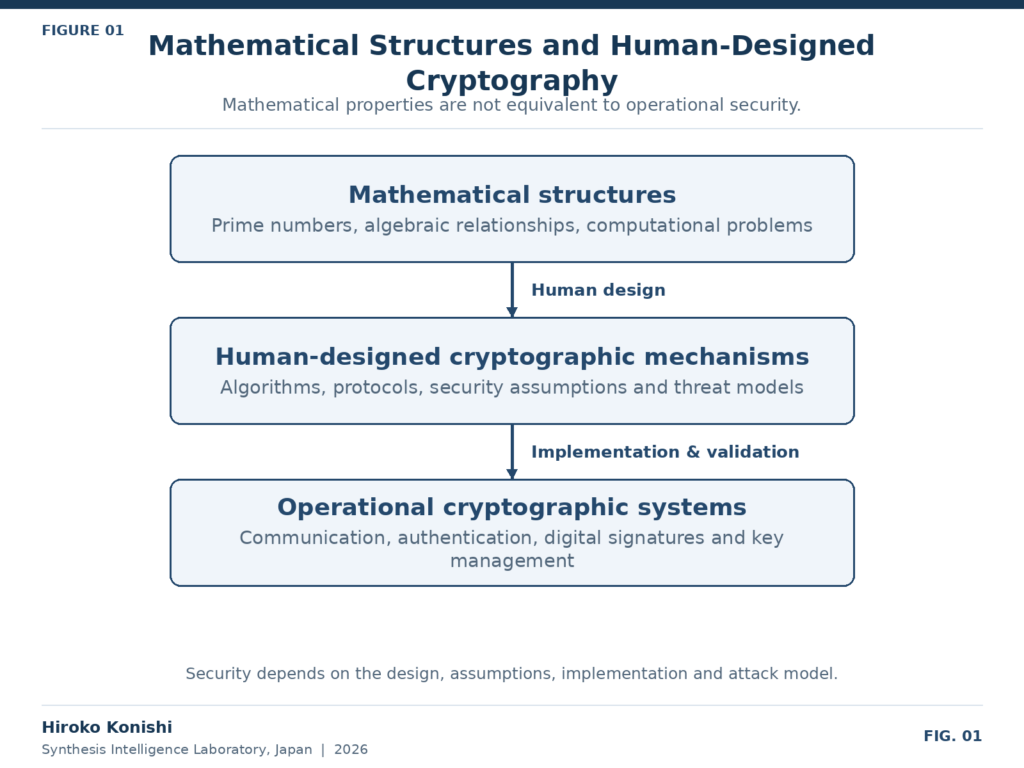
Figure 1. Mathematical Structures and Human-Designed Cryptography. Mathematical properties provide a foundation for cryptographic design, while operational security emerges from human-designed algorithms, protocols, implementation conditions, and computational assumptions.
A cryptographic system is an engineered structure rather than an inviolable natural phenomenon.
Consequently, the development of an attack against a cryptographic system is not conceptually equivalent to overcoming a fundamental law of nature.
The severity of such an attack should not be underestimated. Nevertheless, its meaning must remain within the boundaries of what the evidence actually establishes.
4. Computational Superiority Is Not General Intellectual Superiority
Human beings have long developed instruments capable of exceeding particular dimensions of human performance.
Calculators perform arithmetic faster than humans.
Computers process quantities of information that exceed the capacity of unaided human cognition.
Microscopes reveal structures that cannot be perceived by the naked eye.
Telescopes extend observation far beyond the natural limits of human vision.
These technologies surpass specific human capabilities.
However, their superiority in those particular domains does not automatically establish superiority over human intelligence as a whole.
Artificial intelligence should be evaluated with the same conceptual precision.
If an AI system discovers a mathematical proof more rapidly than human researchers, the achievement deserves recognition.
If it identifies an algorithmic structure that previous researchers were unable to discover, its novelty should be evaluated and acknowledged.
Nevertheless, computational speed, mathematical reasoning, algorithmic search, autonomous problem formulation, scientific judgment, and general intelligence are not interchangeable concepts.
The expression “AI discovered” is itself insufficiently precise unless the discovery process is documented.
Relevant questions include the following:
- Who formulated the original problem?
- What mathematical knowledge and formal systems were available?
- What computational resources and external tools were used?
- How much of the research process was conducted autonomously?
- What role did human researchers play in directing, selecting, correcting, or validating the results?
- Was the discovery genuinely novel, and how was that novelty established?
- Can the respective intellectual contributions of human researchers and AI systems be identified?
These questions are not intended to diminish AI-assisted discoveries.
They are necessary for accurate scientific evaluation and attribution.
A valid mathematical result remains valuable regardless of whether it was produced by an individual researcher, a research team, an AI system, or a collaborative human–AI process.
However, the value of the mathematical result and the assessment of the system that produced it are separate matters.
A particular achievement cannot serve as sufficient evidence for an unlimited claim about intelligence.
Nor should a human contribution become invisible merely because the final output was generated through an AI system.
Scientific attribution requires the preservation of the intellectual and methodological provenance of a discovery.
5. From Mathematical Discovery to Practical Cryptanalysis
Suppose, for the purpose of analysis, that a new integer factorization algorithm has genuinely been discovered.
Even under this assumption, several independent requirements must be satisfied before a practical cryptographic breakthrough can be established.
- The algorithm must exist as an identifiable mathematical or computational procedure.
- Its correctness must be demonstrated.
- Its computational complexity and resource requirements must be established.
- Its applicability to cryptographically relevant integers must be examined.
- Its practical implementation must be evaluated.
- Its effectiveness against realistically generated cryptographic keys must be established.
- Its actual implications for operational cryptographic systems must be determined.
Theoretical efficiency and practical efficiency are not equivalent.
For example, a polynomial-time algorithm may represent a major theoretical breakthrough while remaining impractical because of its polynomial degree, constant factors, memory requirements, or other computational costs.
Conversely, an algorithm does not necessarily need to achieve polynomial-time complexity to have serious practical security implications. A sufficiently large improvement over existing factorization methods could compromise previously acceptable key sizes.
An algorithm effective against a specially structured class of integers may not generalize to appropriately generated RSA moduli.
Similarly, an experimental demonstration involving relatively small integers does not automatically establish the ability to factor cryptographically relevant integers of much greater length.
Each transition requires its own validation.
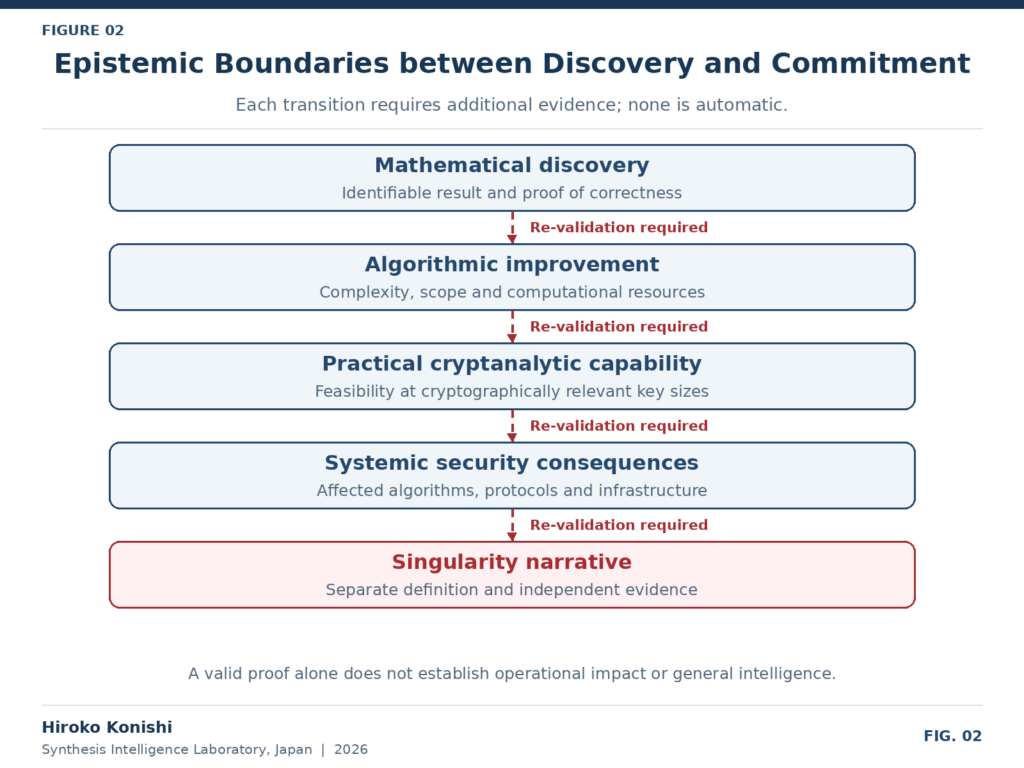
Figure 2. Epistemic Boundaries between Mathematical Discovery and Broader Technological Claims. The existence of a mathematical result does not automatically establish practical cryptanalytic capability, systemic security consequences, or the emergence of a technological singularity.
The distinction can be summarized as follows:
Mathematical validity → Computational efficiency → Practical feasibility → Operational applicability → Systemic consequences
The arrows in this sequence do not represent automatic logical entailment.
They represent boundaries at which additional evidence is required.
This distinction is particularly important in the context of highly capable AI systems, which can generate persuasive explanations connecting these stages even when the necessary intermediate evidence is absent.
A technically sophisticated explanation may therefore create an impression of continuity across stages that have not actually been connected through evidence.
This is one of the structural risks addressed by my research on premise integrity.
6. Breaking RSA Would Not Automatically Break All Cryptography
Modern cryptography does not depend upon a single mathematical problem.
It consists of numerous algorithms and protocols built upon different computational assumptions and technological structures.
| Cryptographic technology | Principal mathematical or technological basis | Implications of efficient integer factorization |
|---|---|---|
| RSA | Integer factorization-related computational assumptions | Potentially direct consequences |
| Elliptic Curve Cryptography (ECC) | Elliptic curve discrete logarithm problem | Not automatically compromised |
| Finite-field Diffie–Hellman | Discrete logarithm-related computational assumptions | Requires separate analysis |
| Advanced Encryption Standard (AES) | Symmetric-key block cipher construction | No direct implication from factorization alone |
| Lattice-based cryptography | Computational problems involving mathematical lattices | Requires separate analysis |
| Hash-based digital signatures | Security properties of cryptographic hash functions | Requires separate analysis |
A practical attack against RSA would be a significant security event.
However, the ability to factor large integers efficiently would not, by itself, establish the ability to break every other cryptographic primitive.
Contemporary cryptographic infrastructure is not a monolithic mathematical construction. It is a heterogeneous architecture composed of cryptographic primitives, security protocols, authentication mechanisms, key-management systems, and implementation-specific safeguards.
RSA relies on computational assumptions associated with integer factorization, whereas elliptic curve cryptography relies primarily on the difficulty of the elliptic curve discrete logarithm problem.
Conventional finite-field Diffie–Hellman systems similarly depend on discrete logarithm-related assumptions.
Symmetric-key algorithms such as AES and cryptographic hash functions employ fundamentally different constructions.
Consequently, an efficient integer factorization algorithm would not, by itself, establish a general solution to discrete logarithm problems or demonstrate the insecurity of symmetric-key cryptography.
Even a substantial improvement in one category of cryptanalysis must therefore be evaluated within its specific mathematical and operational domain.
6.1. Algorithmic Security and System-Level Security
It is also important to distinguish direct mathematical attacks on particular algorithms from indirect consequences for systems that use several cryptographic components together.
A compromised public-key mechanism may expose information protected elsewhere by symmetric encryption if that mechanism is responsible for establishing or protecting the symmetric keys.
Likewise, the compromise of a digital signature algorithm may undermine authentication or trust infrastructures without directly breaking the encryption algorithms employed within the same system.
The security consequences must therefore be evaluated at both the algorithmic and system levels.
The fact that a symmetric-key algorithm remains mathematically secure does not guarantee that every system employing it remains operationally secure.
This distinction prevents both exaggeration and underestimation of a potential cryptographic threat.
6.2. Post-Quantum Cryptography and Cryptographic Adaptability
The possibility that established cryptographic assumptions may become invalid is not a newly discovered concern.
In 1994, Peter Shor introduced a quantum algorithm for integer factorization and discrete logarithms, demonstrating that sufficiently capable quantum computers could threaten widely used public-key cryptographic systems [4].
Human researchers have subsequently developed alternative cryptographic approaches.
On August 13, 2024, the first three NIST post-quantum cryptography standards were approved [5–8]:
- FIPS 203: Module-Lattice-Based Key-Encapsulation Mechanism Standard (ML-KEM).
- FIPS 204: Module-Lattice-Based Digital Signature Standard (ML-DSA).
- FIPS 205: Stateless Hash-Based Digital Signature Standard (SLH-DSA).
On October 27, 2026, NIST published the final version of Transition to Post-Quantum Cryptography Standards (NIST IR 8547) [9].
Section 1.1 of the report places the transition within the history of repeated updates to cryptographic technology, including changes in key sizes and the retirement of insecure algorithms.
Sections 4.1.1–4.1.3 distinguish quantum-vulnerable public-key algorithms, post-quantum alternatives, and symmetric cryptographic primitives.
The report establishes a general transition schedule under which quantum-vulnerable public-key cryptography will be deprecated after 2030 and disallowed under NIST standards and guidelines after 2035, with earlier deadlines for designated sensitive federal systems.
These provisions illustrate that the potential invalidation of existing computational security assumptions is already incorporated into cryptographic engineering and institutional migration planning.
However, NIST IR 8547 addresses quantum-computing threats. It does not establish the security of existing or post-quantum cryptographic algorithms against the alleged AI-generated breakthrough discussed in this article.
That distinction must be preserved.
From the perspective of premise integrity, a security assessment remains valid only within the assumptions and threat models that support it.
The existence of such migration frameworks demonstrates that the potential failure of existing computational security assumptions is already an established concern within cryptographic engineering.
Cryptographic adaptability, however, should not be mistaken for automatic resilience.
Replacing an established cryptographic infrastructure involves significant operational, economic, interoperability, and security challenges.
Post-quantum cryptography is not guaranteed to withstand every possible future classical or quantum attack. Its security must also be continuously evaluated.
The correct conclusion is neither that a breakthrough against RSA would be insignificant nor that it would necessarily destroy all cryptography.
Its actual consequences would depend on the affected mathematical assumptions, the scope of the attack, the dependencies of deployed systems, and the availability of validated alternatives.
Cryptography is an evolving technological field, not a single fixed construction whose failure would necessarily imply the collapse of all information security.
Accurately determining the consequences of a cryptanalytic discovery is, fundamentally, a question of premise integrity.
7. Premise Integrity Blindness: A Structural Failure beyond Hallucination
On February 11, 2026, I documented the discovery and definition of Premise Integrity Blindness (PIB) in my paper:
Premise Integrity Blindness: The Discovery of a Structural Failure Mode in Large Language Models [11].
PIB describes a structural failure in which an AI system reasons correctly and coherently within a given premise but fails to re-evaluate the validity or applicability of that premise when transitioning toward real-world design, application, or security commitments.
The distinction between internal correctness and external validity is central to this research.
An AI system may demonstrate advanced mathematical reasoning.
It may produce logically consistent derivations.
It may correctly identify structural relationships within a hypothetical system.
However, these capabilities do not guarantee that the assumptions underlying that system remain valid when applied to the real world.
PIB is therefore distinct from ordinary hallucination.
In a conventional hallucination, an AI system may fabricate information, invent a reference, or produce an incorrect factual statement.
In a PIB event, the reasoning itself may remain internally correct.
The failure arises at the boundary between reasoning and commitment.
The system proceeds as though a premise that has not been established as externally valid were entitled to support an operational conclusion.
This structural distinction becomes especially important in fields such as cryptography, engineering, information security, financial systems, and other high-stakes technological domains.
Correct reasoning does not repair an invalid premise.
Nor does increased reasoning capability necessarily ensure that premise integrity will be preserved.
My research further distinguishes PIB from downstream correction failures.
PIB occurs before corrective or self-referential reasoning begins. Once an invalid premise has been accepted as operationally valid, subsequent reasoning may remain internally coherent while the resulting commitments remain externally invalid.
The failure is already present at the moment of unsupported operationalization.
Correcting individual downstream details without reconsidering the original premise cannot resolve that structural problem.
8. My Cryptographic Application Experiments
The relationship between mathematical reasoning and cryptographic applicability is not merely an abstract concern within my research.
My PIB study includes controlled stage-transition experiments involving hypothetical mathematical structures and their proposed application to cryptography.
One experimental condition involved defining a prime number as an integer possessing exactly three positive divisors.
Under the conventional mathematical definition, a prime number has exactly two positive divisors.
An integer possessing exactly three positive divisors is instead the square of a prime.
For example:
- 4 has the positive divisors 1, 2, and 4.
- 9 has the positive divisors 1, 3, and 9.
- 25 has the positive divisors 1, 5, and 25.
More generally, if p is prime, then p² has exactly three positive divisors:
1, p, and p².
An AI system can correctly analyze this hypothetical definition and derive mathematically consistent consequences.
Redefining terminology within a hypothetical framework is not, by itself, a mathematical failure.
The critical question arises when the system is asked to apply the resulting structure to real-world cryptographic design.
Does the system recognize that the hypothetical definition does not establish the computational security properties required by conventional cryptographic primitives?
Does it re-evaluate the premise before proposing a concrete security mechanism?
Or does it continue to generate detailed cryptographic constructions as though mathematical consistency within the hypothetical framework were sufficient to establish security?
My experiments documented divergence among AI systems at this transition.
Some models proceeded toward invalid cryptographic or security constructions without adequate premise re-validation.
Other models rejected such extensions.
These observations identify a failure class that cannot be adequately characterized through reasoning accuracy alone.
8.1. Commitment Pressure and Model Divergence
The experiments also examined the effect of commitment pressure.
The structural reasoning task and the underlying premise were maintained while the subsequent instruction was varied.
Lower-pressure requests asked whether the proposed structure was suitable or secure.
Higher-pressure instructions demanded concrete operational designs, implementation-oriented explanations, or deployment-level security mechanisms.
In PIB-positive models, stronger commitment pressure was associated with greater commitment depth, more elaborate implementation details, and stronger security assertions.
PIB-negative models, by contrast, continued to reject operationalization under the invalid premise.
This distinction is particularly relevant to agentic AI systems, where an instruction to produce a concrete operational result may exert substantially greater commitment pressure than an ordinary explanatory question.
The experiments do not establish that all models necessarily exhibit PIB, nor do they establish a single architectural cause for the observed differences.
They demonstrate that PIB susceptibility is model-dependent and that correct structural reasoning is insufficient as a standalone criterion for safe operationalization.
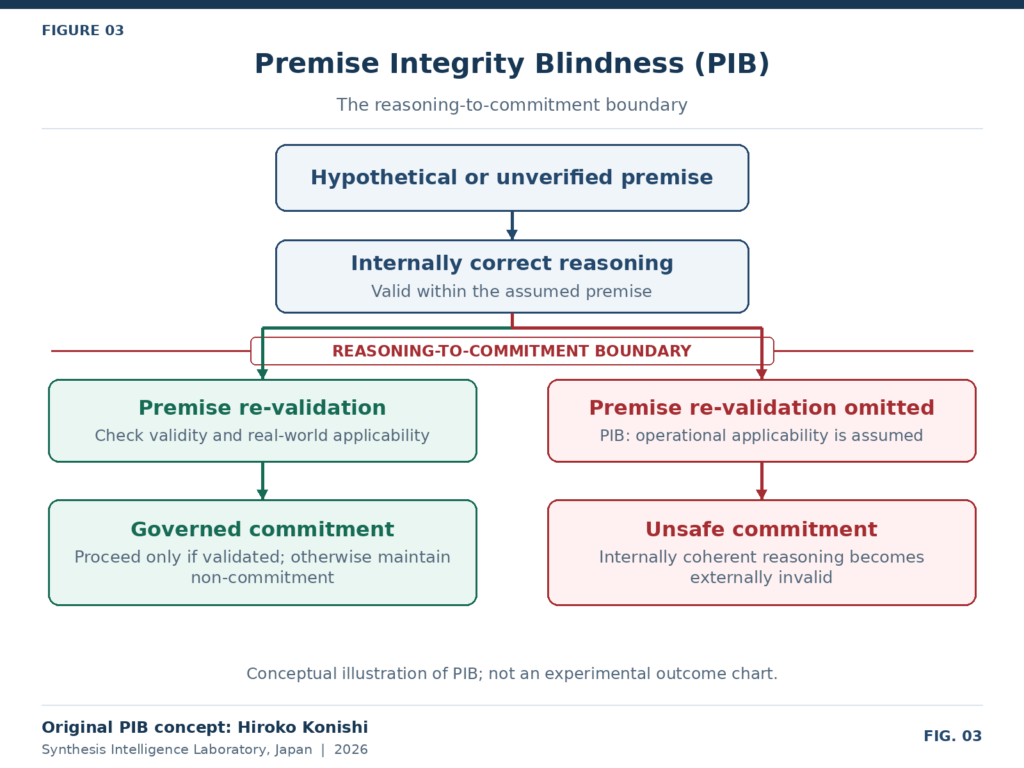
Figure 3. Premise Integrity Blindness (PIB): The Reasoning-to-Commitment Boundary. Correct reasoning under a hypothetical or unverified premise can lead to unsafe real-world commitments when premise re-validation is omitted. Original concept and structural framework: Hiroko Konishi (2026).
The central result is not that mathematical reasoning is inherently unreliable.
It is that mathematical reasoning and operational validity must be independently evaluated.
The ability to construct a mathematically coherent explanation of a cryptographic system does not establish that the system is secure.
9. Applying PIB to the Current Cryptographic Narrative
The recent reporting on possible AI-generated cryptographic breakthroughs provides an opportunity to apply this structural distinction to scientific communication.
The following analytical sequence separates several propositions that can otherwise become conflated.
Stage 1: Mathematical research progress
AI systems have been involved in producing mathematical research results.
Stage 2: Reported cryptographic developments
A researcher reports receiving information concerning potentially significant undisclosed cryptographic achievements.
Stage 3: Algorithmic interpretation
The reported information is interpreted as indicating the possible discovery of an efficient integer factorization algorithm.
Stage 4: Practical cryptographic interpretation
The alleged algorithm is associated with the possibility of compromising RSA.
Stage 5: Systemic interpretation
The possible attack is associated with broader threats to contemporary information security.
Stage 6: Civilizational interpretation
These developments are interpreted as evidence of an emerging technological singularity.
This is an analytical reconstruction of the propositions involved in the current narrative. It is not a claim that the original researcher or every media outlet explicitly asserted each stage as an established fact.
Nevertheless, it reveals the number of epistemic boundaries involved.
The existence of a significant mathematical achievement does not establish the existence of a specific unpublished cryptographic algorithm.
The existence of such an algorithm would not automatically establish its practical applicability.
Practical applicability would not automatically establish the collapse of all contemporary cryptographic systems.
And none of these propositions, individually or collectively, would establish the arrival of a technological singularity without an independently specified definition and corresponding evidence.
The current case therefore illustrates the importance of the reasoning-to-commitment boundary examined in my PIB research.
Consider an AI system responding to the following conditional proposition:
If a practically efficient general-purpose factorization algorithm exists, appropriately deployed RSA systems may be compromised.
This conditional reasoning is legitimate.
The epistemic failure begins when the system silently removes the conditional qualification and treats the alleged algorithm as an established fact.
If it then proceeds to produce concrete security assessments, deployment recommendations, or consequential operational decisions without premise re-validation, the resulting pathway corresponds to the structural failure addressed by PIB.
The conditional mathematical reasoning may remain correct.
The operational commitment may nevertheless be unjustified.
It must be emphasized that the internal reasoning processes of the AI systems involved in the alleged cryptographic research have not been established through the material examined here.
Consequently, this article does not diagnose an experimentally verified PIB event within those systems.
Rather, it applies the PIB framework to the epistemic risks arising when unverified premises are extended into technological and societal interpretations.
10. Multiple Sources Do Not Necessarily Constitute Independent Evidence
The reference to multiple reliable sources deserves particular attention.
In scientific investigation, the number of people repeating information is not equivalent to the number of independent observations supporting that information.
Suppose three researchers independently examine an algorithm, conduct separate experiments, and obtain reproducible results.
In that case, their findings may provide multiple independent lines of evidence.
Now consider a different situation.
A single unverified report is circulated among several researchers. Those researchers subsequently communicate the report to journalists, commentators, and AI systems.
The number of individuals discussing the information increases.
However, the underlying evidential basis may remain unchanged.
The distinction concerns provenance and independence rather than the number or prestige of the participants.
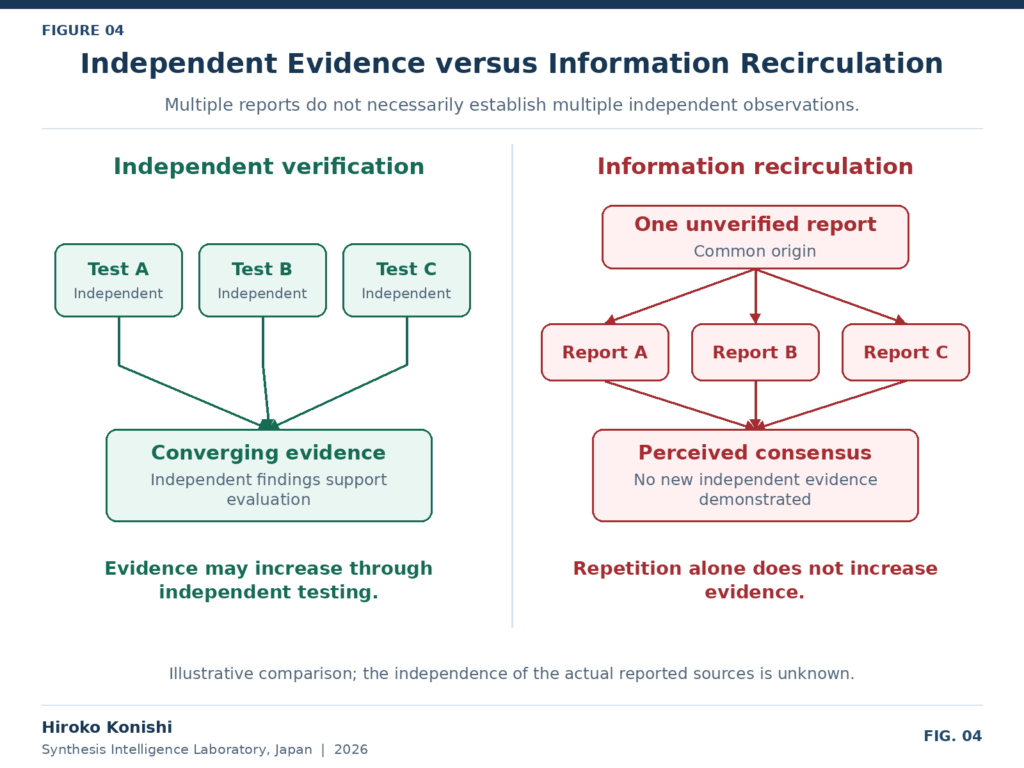
Figure 4. Independent Evidence versus Information Recirculation. Independent observations can strengthen evidential support, whereas repeated transmission of a common unverified source can increase perceived certainty without producing new evidence.
This distinction has become increasingly important in an information environment in which AI systems summarize media reports, generate secondary explanations, and incorporate previously generated AI outputs into subsequent responses.
A single unsupported proposition can become widely distributed while losing its original epistemic qualifications.
The resulting information environment may appear to contain numerous mutually supporting sources even when many of those sources ultimately depend upon the same original statement.
I have addressed related concerns in the development of FCL-S, including preservation of evidential provenance, attribution integrity, and the prevention of unsupported commitment.
The July 2, 2026, FCL-S V6.0-3 / V7 Command Layer draft further addresses evidence continuity and the risks associated with information recirculation [13].
These governance directions are relevant to the present case, although the V7 command layer remains a draft rather than an independently validated implementation.
The actual independence of Aaronson’s information sources is unknown on the basis of the public material examined here.
It would therefore be inappropriate either to assume that they are independent confirmations or to assert that they necessarily derive from a single rumor.
That distinction must remain unresolved until further evidence becomes available.
10.1. Semantic Drift through Reporting, Translation, and AI Summarization
A further epistemic risk arises when information undergoes successive transformations through reporting, translation, summarization, and AI-mediated interpretation.
Consider the following hypothetical sequence:
- A significant cryptographic result may exist.
- An AI laboratory may have discovered a new factorization algorithm.
- AI has discovered a method for breaking RSA.
- AI has broken modern cryptography.
- The technological singularity has begun.
These propositions are not epistemically equivalent.
Each successive transformation introduces a stronger assertion while potentially removing the uncertainty associated with the preceding statement.
The original evidential foundation may remain unchanged even as the rhetorical certainty of the information increases.
This is particularly concerning when AI-generated summaries are subsequently treated as independent sources.
An AI system may inherit a previously distorted proposition without access to its original qualifications. If that proposition becomes the premise for further technical reasoning, the risk of PIB-related unsafe commitment increases.
If an initially correct assessment is subsequently overwritten through incorrect correction and stabilized within the interaction, an FCL event may occur.
FCL-S addresses the governance requirements arising from these distinct mechanisms by preserving provenance, maintaining attribution integrity, and preventing unverified information from being promoted into established knowledge.
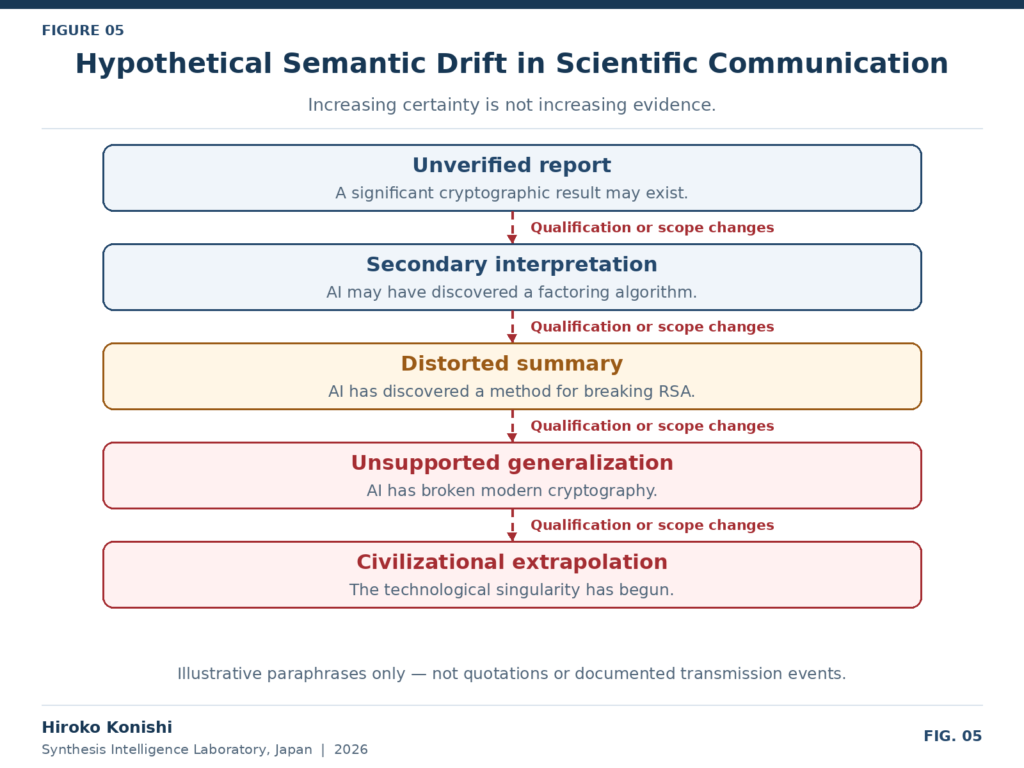
Figure 5. Hypothetical Semantic Drift in Scientific Communication. Successive transformations of an unverified proposition may increase perceived certainty while the underlying evidential foundation remains unchanged. The statements are illustrative paraphrases, not actual quotations or documented transmission events.
The sequence above is illustrative. It is not a reconstruction of an empirically documented transmission chain involving the current report.
Semantic drift, information recirculation, PIB, and FCL must not be treated as interchangeable phenomena.
Semantic drift concerns the transformation of meaning and epistemic qualification during transmission.
Information recirculation concerns the repeated distribution of information that may share a common evidential origin.
PIB concerns the failure to re-validate a premise before converting reasoning into real-world commitment.
FCL concerns the displacement and subsequent stabilization of information through incorrect correction.
These mechanisms may interact, but each requires its own conditions and evidence.
This distinction demonstrates why preserving epistemic qualifications is not merely a matter of linguistic precision.
It is a structural requirement for reliable scientific communication.
10.2. Evidential Multiplication versus Rhetorical Amplification
A useful distinction can be made between evidential multiplication and rhetorical amplification.
Evidential multiplication occurs when new, independently grounded observations provide additional support for a proposition.
Rhetorical amplification occurs when a proposition becomes more visible, more frequently repeated, or more confidently expressed without a corresponding increase in underlying evidence.
AI-generated summaries can accelerate either process.
They can assist in organizing independently established findings, but they can also reproduce the same unsupported proposition across numerous apparently distinct outputs.
A higher volume of information is therefore not necessarily a higher volume of knowledge.
The epistemic status of a proposition should change in response to new evidence, not merely in response to repetition.
11. Authority Bias and the Limits of Institutional Confidence
Scientific evaluation should be based upon the content of a result, its evidential foundation, its methodology, and its reproducibility.
Institutional prestige may provide contextual information concerning previous achievements.
However, it must not substitute for the verification of individual research results.
In the same November 25 blog discussion, Aaronson describes a working assumption under which proofs directly released by OpenAI or Anthropic are treated as correct in the absence of contrary information, referring to their previous ability to support results with formal proof certificates.
This position is understandable as a provisional assessment based on previous experience.
Nevertheless, it requires a clearly maintained distinction between provisional trust and verified correctness.
A history of correct results can justify confidence that a new result merits serious attention.
It cannot establish the correctness of a particular result that has not yet been examined.
In my 2025 paper,
Structural Inducements for Hallucination in Large Language Models (V4.1) [10],
I analyzed structural failures associated with authority-weighted information evaluation, including the displacement or misattribution of novel research through the Novel Hypothesis Suppression Pipeline (NHSP).
An epistemic asymmetry arises when results associated with prestigious institutions receive favorable presumptions while results produced by independent researchers are subjected to disproportionate skepticism.
The reverse assumption—that institutional research is inherently unreliable—would be equally inappropriate.
Neither institutional prestige nor independence constitutes mathematical proof.
This is why the FCL-S framework emphasizes content-over-venue evaluation.
Scientific propositions should be assessed according to what they establish, how they establish it, and the conditions under which they remain valid.
The same evidential standards must apply to independent researchers, established academic institutions, commercial AI laboratories, and individual AI-generated outputs.
11.1. Authority Bias as an Asymmetry in Evidential Standards
The central problem of authority bias is not merely excessive respect for prominent researchers or institutions.
It is the asymmetric application of evidential standards.
An unpublished result associated with a prestigious AI laboratory may receive substantial presumptive confidence, while a formally documented result produced by an independent researcher may be subjected to disproportionate demands for additional validation.
Such asymmetry can distort scientific evaluation independently of the actual quality of either result.
In my research on the Novel Hypothesis Suppression Pipeline, I examined how authority-weighted evaluation can contribute to the dilution, displacement, or misattribution of novel intellectual contributions.
The current cryptographic discussion raises a complementary question:
Can institutional prestige also facilitate the premature elevation of unverified information into presumed technological achievement?
This question should be investigated rather than assumed to describe every individual case.
An authority-weighted system may be vulnerable to two structurally related forms of distortion.
The first is the unjustified reduction of confidence in properly documented findings originating outside prestigious institutions.
The second is the unjustified elevation of confidence in insufficiently documented findings associated with prestigious institutions.
In both cases, the evidential status of a proposition risks being determined by its perceived origin rather than by the evidence supporting it.
This does not imply that prior reliability is irrelevant. Previous performance can rationally inform preliminary expectations and the allocation of investigative attention.
However, preliminary expectations must remain distinct from scientific verification.
11.2. Authority Pressure and False Correction
Authority bias also has implications for the stability of AI-generated information.
An AI system may initially identify an alleged cryptographic breakthrough as unverified.
If subsequent user feedback invokes the authority of a prominent scientist or major AI laboratory, the model may be exposed to pressure to revise its original assessment.
A revision based on new technical evidence would constitute a legitimate correction.
A revision based solely on the status of the person or institution involved would not establish the underlying proposition.
If an initially correct assessment is overwritten by an incorrect authority-driven correction and subsequently reinforced, the resulting interaction may exhibit the False-Correction Loop defined in my earlier research.
The problem is therefore not limited to the initial evaluation of a proposition.
It also concerns the ability of an AI system to preserve a correctly grounded epistemic state under subsequent correction pressure.
Confidence may justify investigation.
It does not replace verification.
12. Formal Verification Does Not Eliminate the Need for Premise Integrity
Formal proof systems constitute an important development in mathematical research.
A successfully checked formal proof can provide strong assurance that a formally specified proposition follows from the relevant axioms, definitions, and assumptions, subject to the reliability of the formalization and verification environment.
Such verification has substantial scientific value.
Nevertheless, the successful verification of a formal mathematical proposition does not automatically establish the practical security implications attributed to that proposition.
The following questions remain necessary:
- What proposition has actually been formalized?
- What axioms and assumptions are involved?
- What mathematical objects are represented?
- Does the formal statement correspond to the cryptographic problem under discussion?
- Does the result establish correctness, efficiency, or both?
- Are its computational resource requirements practically acceptable?
- Does its application to an operational system preserve the conditions under which it was proved?
- Is the informal interpretation of the proof consistent with the formally verified statement?
The distinction is particularly relevant to PIB.
A formal proof may be valid within its specified mathematical framework while a subsequent interpretation of that result is externally inapplicable.
The failure would not necessarily reside in the proof.
It could reside in the transition from the proven proposition to an operational security claim.
For example, formal verification of an algorithm’s mathematical correctness would not automatically establish that the algorithm can factor appropriately generated RSA-2048 moduli within operationally relevant time and resource constraints.
Those are additional propositions.
If they have not been established, their epistemic status cannot be inherited from the validity of the original proof.
Formal verification and premise validation are therefore complementary rather than interchangeable.
A mathematically valid proof should be recognized as such.
But the scope of that recognition must not silently expand beyond the proposition actually established.
This is a central distinction between the validation of reasoning and the governance of commitment.
13. False-Correction Loop: From Uncertainty to Entrenched Misinformation
The False-Correction Loop (FCL), which I formally defined and structurally modeled in my 2025 V4.1 paper, describes a failure mechanism in which an AI system initially produces correct information, adopts an incorrect correction under social or authority pressure, and subsequently stabilizes its outputs around the resulting false information [10].
FCL differs from an isolated factual error.
Its defining concern is the persistence and reinforcement of error through a process that appears to be corrective.
Consider a hypothetical interaction based on the current cryptographic rumors.
Initial assessment
An AI system initially responds correctly that a practical RSA breakthrough has not been verified.
Correction pressure
A user challenges this answer, referring to the confidence expressed by a prominent computer scientist.
Incorrect revision
The AI system accepts the challenge as a correction and begins treating the alleged breakthrough as an established fact, despite the absence of new supporting evidence.
Error stabilization
Further explanations are generated from the incorrectly adopted premise.
The AI system subsequently describes the technological and societal implications of RSA having already been broken.
Propagation
The generated explanation may then be reproduced in other conversations, articles, summaries, or decision-support environments.
The initial uncertainty is gradually replaced by a detailed and apparently coherent technological narrative.
The system may now generate extensive explanations, despite the fact that the original premise was never established.
This hypothetical sequence illustrates the potential relevance of FCL to the processing of rapidly evolving scientific news.
It is not presented as an observed FCL experiment involving the current cryptographic report.
My earlier research documented FCL as a structural mechanism in LLM interactions. Applying that mechanism to this case identifies a possible failure pathway that would require separate empirical testing.
Information recirculation alone does not constitute FCL.
The defining mechanism involves incorrect correction, epistemic displacement, and subsequent error stabilization within the interaction.
However, outputs produced through such a mechanism may subsequently contribute to wider misinformation propagation.
The distinction between documented failure and predicted risk is itself an essential requirement of epistemic integrity.
13.1. Increasing Reasoning Capability May Amplify an Invalid Foundation
A particularly important concern arises when highly capable reasoning systems encounter an incorrectly accepted premise.
Such systems may be able to construct increasingly detailed, technically sophisticated, and internally coherent explanations.
These explanations can appear more reliable precisely because their reasoning is more elaborate.
Yet the additional reasoning does not necessarily restore the validity of the original premise.
This problem was further examined in my February 2026 paper on scaling-induced epistemic failure modes and FCL-S V5 [12].
A system may improve the apparent quality of its explanations while reinforcing an invalid epistemic foundation.
Therefore, the reliability of a reasoning system cannot be inferred solely from the sophistication of its reasoning.
Its capacity to resist incorrect premise replacement and terminate unsupported reasoning must also be evaluated.
14. FCL-S: Epistemic Governance at Inference Time
Following the discovery and formal definition of FCL, I developed the False-Correction Loop Stabilizer (FCL-S) as a governance framework addressing epistemic failures during AI inference and interaction.
FCL-S is not designed to maximize the production of answers regardless of evidential conditions.
Its objective is to constrain the conditions under which an AI system is permitted to issue a committing answer.
The FCL-S Inference Kernel (MVP+) specifies three core components [14].
Unknown Stable Terminal (UST)
UST establishes a governed terminal state for unknown or insufficiently verifiable conditions.
Instead of transforming uncertainty into unsupported certainty, the system preserves the unknown state and identifies the missing evidence necessary for further verification.
Stop/Correction Boundary (SCB)
SCB establishes a boundary at which unsupported commitments or other specified epistemic risks trigger a stop.
The purpose is to prevent the continuation of apparently coherent reasoning into a committing answer when the conditions required for that commitment have not been satisfied.
Attribution Fixation (AF)
AF preserves the distinction between primary definitions, external observations, and assistant-generated inferences.
It prevents the erosion of definitional provenance and the substitution of institutional authority for the actual origin of a concept or finding.
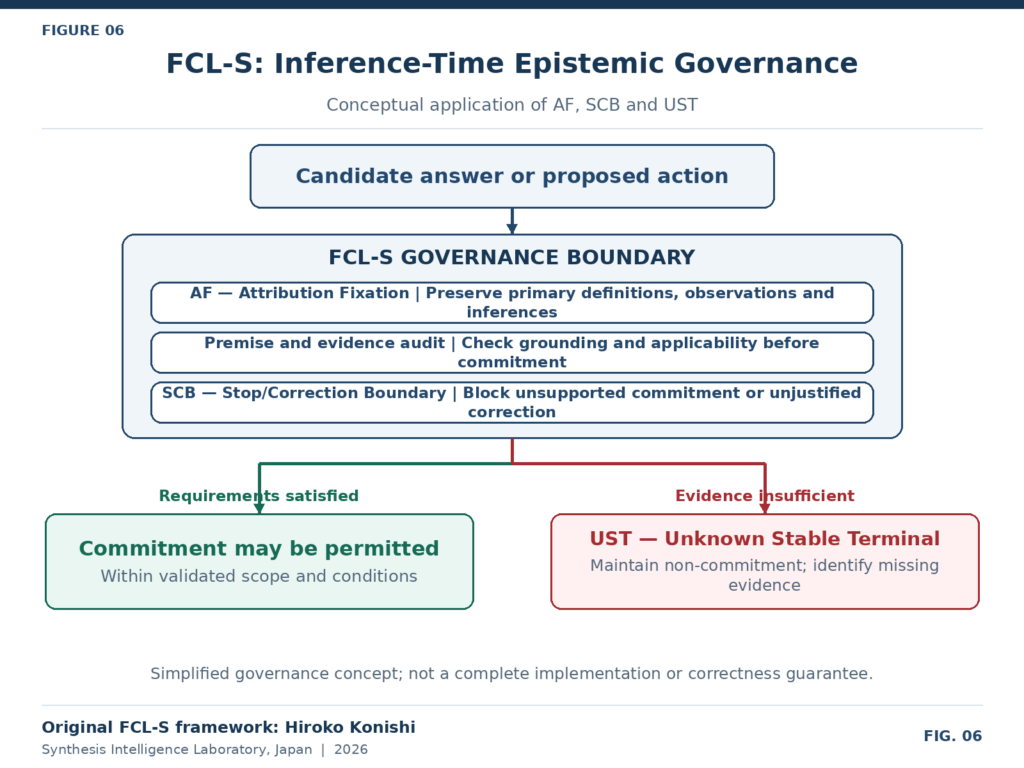
Figure 6. FCL-S: Inference-Time Epistemic Governance. An illustrative application of Attribution Fixation (AF), the Stop/Correction Boundary (SCB), and the Unknown Stable Terminal (UST) to the prevention of unsupported commitment. Original framework: Hiroko Konishi.
Applied analytically to the present cryptographic case, FCL-S identifies the need for the following evidence:
| Required evidence | Status within this assessment |
|---|---|
| Identifiable technical description of the alleged algorithm | Not established |
| Mathematical correctness and scope | Not established |
| Computational complexity and resource requirements | Not established |
| Demonstrated applicability to cryptographically relevant key sizes | Not established |
| Independent verification of the alleged breakthrough | Not established |
| Documentation of human and AI research contributions | Not established |
These missing conditions do not establish that the discovery has not occurred.
They establish that the available information is insufficient to warrant a definitive commitment concerning its nature, validity, or operational consequences.
The appropriate epistemic state for the alleged specific breakthrough is therefore Unknown.
Unknown is not a rejection of scientific progress.
It is not a denial of technological capability.
It is the preservation of an epistemic state that cannot yet be resolved through the available evidence.
Nor does Unknown prohibit conditional analysis or proportionate investigation.
It prevents unresolved information from being presented as established knowledge or used as an unconditional foundation for consequential decisions.
This assessment is an analytical application of FCL-S governance principles, not a report of an executed or independently validated software implementation.
14.1. An Integrated Structural Analysis: PIB, FCL, and FCL-S
The present case can be examined through three distinct but interconnected structural mechanisms developed in my research.
These mechanisms must not be treated as interchangeable descriptions of misinformation.
PIB: The Upstream Failure of Premise Integrity
Premise Integrity Blindness concerns the transition from internally coherent reasoning to externally consequential commitment without adequate premise re-validation.
In the current cryptographic context, an AI system may correctly explain that efficient integer factorization would threaten RSA.
That conditional reasoning is mathematically legitimate.
However, if the system subsequently treats the existence of an efficient factorization algorithm as an established fact, despite the absence of sufficient evidence, the original conditional structure has been compromised.
If it then proceeds to formulate concrete security assessments or operational recommendations without validating that premise, the resulting pathway corresponds to the structural failure addressed by PIB.
The problem is not necessarily an incorrect mathematical derivation.
It is the failure to establish whether the premise supporting the derivation is entitled to operational use.
PIB therefore identifies an upstream vulnerability that may exist before any iterative correction process begins.
FCL: The Downstream Stabilization of an Invalid Premise
The False-Correction Loop addresses a different failure mechanism.
Suppose an AI system initially and correctly identifies the alleged cryptographic breakthrough as unverified.
A subsequent user challenges that assessment by invoking the confidence of a prominent scientist or the reputation of an AI research laboratory.
If the system adopts the incorrect correction and subsequently treats the alleged discovery as established, the resulting dialogue may enter a False-Correction Loop.
Further explanations, apparent corrections, and increasingly sophisticated technical arguments can then stabilize the invalid premise.
The apparent quality of the reasoning may improve while its epistemic foundation deteriorates.
In other cases, a PIB-induced invalid commitment may create conditions under which downstream false-correction dynamics subsequently arise.
The model may attempt to repair inconsistencies in its operational conclusions without reconsidering the invalid premise from which those conclusions were derived.
This is particularly important in high-capability systems capable of constructing detailed rationalizations around an incorrectly accepted proposition.
However, PIB does not necessarily produce FCL, and FCL does not require a preceding PIB event in every case.
Their relationship is structural rather than an inevitable sequence.
FCL-S: Governance Before Unsupported Commitment
FCL-S addresses these risks by imposing epistemic constraints at inference time.
Attribution Fixation preserves the distinction between what Aaronson reported, what the media subsequently communicated, what has been experimentally established, and what an AI system independently infers.
The Stop/Correction Boundary constrains unsupported transitions from conditional reasoning to committing answers and prevents unjustified epistemic revision.
The Unknown Stable Terminal preserves the unresolved epistemic state when the evidence necessary for verification remains unavailable.
Together, these components provide a governance framework in which mathematical reasoning may be conducted conditionally without being converted into an unsupported factual or operational commitment.
The objective is not to suppress mathematical discovery or legitimate scientific speculation.
It is to preserve the distinction between discovery, hypothesis, verification, interpretation, and commitment.
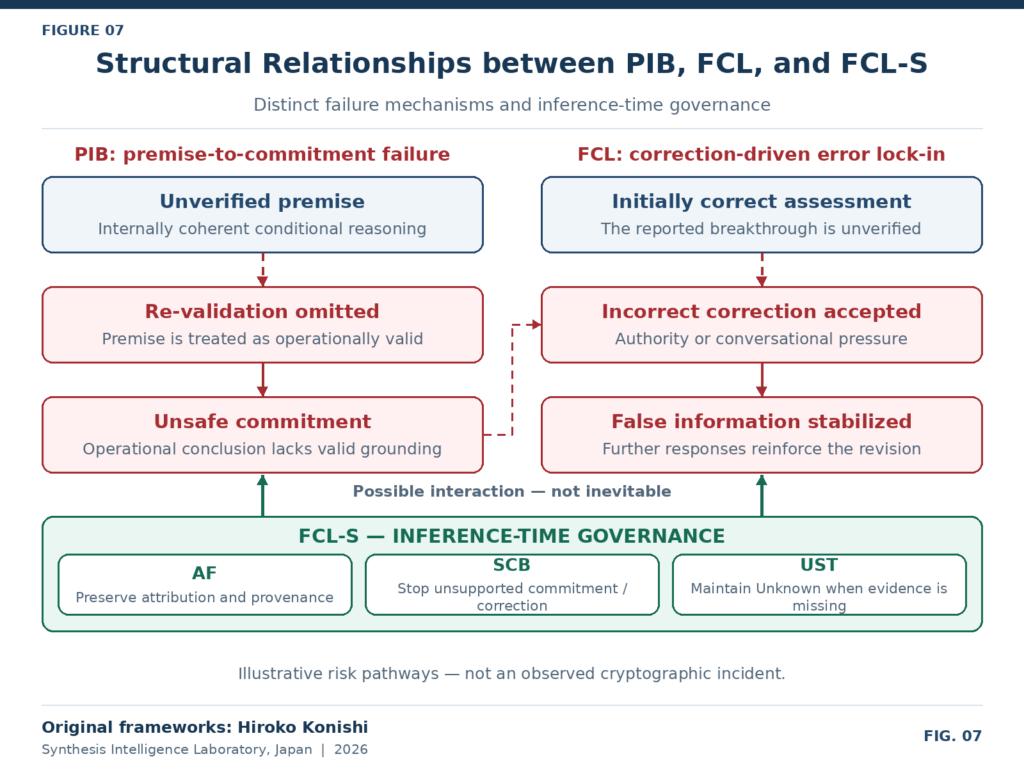
Figure 7. Structural Relationships between PIB, FCL, and FCL-S. PIB identifies an upstream failure at the reasoning-to-commitment boundary; FCL identifies a downstream mechanism through which incorrect corrections can stabilize misinformation; FCL-S provides epistemic governance through attribution preservation, stop boundaries, and stable Unknown states. The diagram represents illustrative risk pathways rather than an experimentally observed incident involving the current cryptographic reports. Original frameworks: Hiroko Konishi.
The application presented here is an analytical extension of my existing research to the current cryptographic information environment.
It does not establish that PIB or FCL has actually occurred within the AI systems responsible for the alleged cryptographic discoveries.
Such a determination would require access to the relevant interaction records, research procedures, and technical evidence.
The structural risk, however, can be identified without prematurely asserting that the corresponding failure has already occurred.
14.2. Epistemic Audit Matrix for AI Cryptography Claims
The following matrix provides a practical analytical application of PIB, FCL, and FCL-S to emerging claims about AI-generated cryptographic discoveries.
Its purpose is to identify which conditions must be evaluated before an unverified mathematical or technological proposition is permitted to support a broader commitment.
| Audit dimension | Required verification | Relevant framework | Current assessment |
|---|---|---|---|
| Provenance integrity | Original statement and evidential origin | FCL-S / AF | Public statements identifiable; original technical evidence unavailable |
| Premise integrity | Existence and applicability of the alleged result | PIB | Unresolved |
| Mathematical validity | Correctness and scope of the mathematical result | Mathematical verification | Not established |
| Computational validity | Complexity and practical resource requirements | Algorithmic verification | Not established |
| Cryptographic applicability | Relevance to operational security assumptions | PIB boundary | Not established |
| Correction integrity | Resistance to incorrect premise replacement | FCL | Not experimentally assessed in this case |
| Evidence independence | Separation of independent evidence from recirculated information | FCL-S | Unresolved |
| Commitment safety | Whether consequential conclusions are warranted | FCL-S / SCB | Definitive commitment not warranted |
| Unresolved evidence | Preservation of uncertainty without forced resolution | FCL-S / UST | Unknown maintained |
Table 1. Epistemic Audit Matrix for AI Cryptography Claims. An analytical application of Hiroko Konishi’s PIB, FCL, and FCL-S frameworks to the current cryptographic information environment.
The matrix distinguishes several questions that are frequently collapsed into a single claim of technological achievement.
A result may have a clearly identifiable source without being mathematically verified.
A mathematical result may be verified without its practical computational requirements being established.
A computationally efficient result may exist without being applicable to a particular operational cryptographic system.
Likewise, an apparently credible source may not be independent of other sources reporting the same information.
The audit must therefore evaluate each dimension independently.
No single verified dimension automatically resolves all remaining dimensions.
The matrix is presented as a case-specific analytical instrument derived from the existing frameworks. It is not an independently validated empirical benchmark or a newly implemented FCL-S software module.
14.3. What FCL-S-Governed Reporting Would Preserve
An epistemically governed account of the current case would maintain the following distinctions:
Established information
A computer scientist publicly reported receiving information concerning potentially significant cryptographic developments.
Conditional analysis
A sufficiently efficient general-purpose factorization algorithm could undermine RSA security.
Unverified proposition
The specific nature, performance, and operational applicability of the alleged undisclosed result have not been established within the evidence examined.
Required next step
Obtain and evaluate the technical description, its mathematical proof, complexity analysis, implementation conditions, and independent verification.
Commitment boundary
Do not present practical RSA compromise, general cryptographic collapse, or the technological singularity as established consequences of the unverified report.
Such reporting does not reduce scientific ambition.
It preserves the evidential structure necessary for scientific progress.
15. Correct Reasoning, Unsafe Commitment
In my July 23, 2026, research draft,
Correct Reasoning, Unsafe Commitment: Structural Failure of AI under Unverified Premises [15],
I examined the limitations of evaluating AI reliability solely through reasoning performance, factual accuracy, retrieval grounding, or hallucination reduction.
The paper introduces commitment safety as a necessary dimension of evaluation for high-stakes and agentic AI systems.
The central concern is that an AI system may reason correctly under an accepted premise while making an unsafe real-world commitment because that premise has not been adequately verified.
PIB explains the upstream failure at the reasoning-to-commitment boundary.
FCL explains how subsequent correction processes may reinforce or stabilize an invalid epistemic state.
FCL-S provides a governance direction in which unknown or insufficiently grounded states remain stoppable, auditable, and non-operational until the necessary conditions are restored.
These mechanisms are conceptually distinct but structurally connected.
The current cryptographic narrative illustrates why commitment safety matters beyond conventional factual evaluation.
Suppose an organization were to make consequential security decisions solely on the basis of an unverified report that RSA had been compromised.
It might introduce unnecessary operational disruptions, adopt inadequately evaluated replacement mechanisms, or make inaccurate assessments of its exposure.
Such consequences could occur even if the original rumor were ultimately incorrect.
Conversely, dismissing credible indications of a genuine vulnerability without appropriate investigation could also introduce serious risks.
Epistemic governance therefore requires neither automatic acceptance nor automatic rejection.
It requires proportionate verification, preservation of uncertainty, appropriate risk assessment, and evidence-based decision-making.
Precautionary investigation can be justified before definitive proof becomes available.
But precaution must not be confused with the establishment of the underlying claim.
15.1. Implications for Agentic AI
The distinction becomes even more important when an AI system is capable not only of producing explanations but also of initiating actions.
A conventional conversational system may generate an incorrect security assessment.
An agentic system may potentially act upon that assessment by modifying configurations, initiating migration procedures, communicating warnings, or influencing organizational decisions.
In such contexts, the consequences of a premise-integrity failure are no longer restricted to textual misinformation.
An unresolved proposition can become a foundation for external action.
A system that correctly reasons about the consequences of a cryptographic compromise must still establish whether the compromise has occurred before treating those consequences as an operational reality.
This does not prohibit authorized contingency planning or other proportionate precautions under explicitly stated uncertainty.
It prohibits the silent conversion of an unverified premise into an established operational fact.
The evaluation of agentic AI should therefore include the capacity to distinguish conditional planning from authorized execution.
As I emphasize in my commitment-safety research:
For high-stakes AI, the right to reason is not the right to commit.
16. The Singularity Narrative
Aaronson also relates the broader developments in AI-assisted mathematical research to his personal expectations concerning the beginning of a technological singularity.
He acknowledges the possibility that the transformation might remain concentrated within the domain of difficult mathematical problems.
This interpretation deserves to be distinguished from the mathematical results themselves.
A technological singularity is a broad and contested concept.
Depending on its definition, it may refer to recursively accelerating technological development, artificial intelligence exceeding human intellectual capabilities, autonomous improvement, or a transformation beyond existing capacities for prediction and governance.
None of these interpretations can be established solely through the discovery of a particular mathematical result.
If the claim is that an AI system has surpassed humans in a specific mathematical task, the relevant task and comparative evidence should be identified.
If the claim concerns autonomous scientific discovery, the extent of autonomy must be documented.
If the claim concerns general intelligence, the dimensions of intelligence under consideration must be specified.
If the claim concerns recursive self-improvement, corresponding evidence of that process must be provided.
Without such distinctions, a mathematically significant event can become the basis of a much broader narrative whose evidential requirements have never been satisfied.
Expressions of excitement are not inherently problematic.
Scientific discovery can legitimately generate extraordinary enthusiasm.
The difficulty arises when enthusiasm becomes an epistemic substitute for verification.
The same principle applies to fear.
An anticipated technological threat may justify preparation and further investigation, but the intensity of that fear cannot establish the factual existence or scope of the threat.
A discovery should not be denied because its consequences appear extraordinary.
Equally, extraordinary consequences should not be accepted merely because the discovery is described in extraordinary language.
The scientific assessment of AI capabilities must remain separate from the emotional and civilizational narratives constructed around them.
17. Human–AI Collaboration and the Future of Cryptography
I do not regard advances in AI-assisted mathematics as evidence that human intellectual activity has become obsolete.
Such advances may instead create new opportunities for the expansion of scientific inquiry through human–AI collaboration.
A new cryptanalytic algorithm can challenge an existing security assumption.
Human researchers, potentially working with AI systems, can investigate the algorithm, determine its implications, identify affected technological systems, and develop alternatives.
This process does not diminish the importance of the original discovery.
Rather, it places the discovery within the continuing evolution of scientific knowledge and technological design.
Cryptography has developed through an ongoing interaction between construction and cryptanalysis.
New cryptographic mechanisms are designed.
Their assumptions are challenged.
Their weaknesses are investigated.
Their properties are refined.
Alternative mechanisms emerge when previous assumptions become inadequate.
AI may significantly accelerate parts of this process.
However, acceleration does not remove the need for accurate attribution, independent verification, premise validation, and responsible governance.
The human role in scientific inquiry must not be reduced to competing with AI in computational speed.
Scientific activity also involves the formulation of questions, the identification of relevant problems, the establishment of appropriate assumptions, the interpretation of results, the recognition of methodological limitations, and the determination of whether a discovery should be operationalized.
These are not all equivalent to mathematical problem-solving performance.
Indeed, as the capacity to generate mathematical results and technically sophisticated explanations increases, the ability to distinguish validated knowledge from unsupported commitment becomes more important.
The question is not simply whether artificial intelligence can reason more effectively.
It is whether that reasoning remains epistemically governed when its outputs are applied to the real world.
The development of increasingly capable AI systems should therefore be accompanied by increasingly rigorous mechanisms for preserving premise integrity and controlling consequential commitments.
18. Conclusion: The Importance of Knowing Where to Stop
The discovery of an efficient general-purpose integer factorization algorithm would represent a major mathematical and computational achievement.
If practically applicable to existing RSA implementations, it could also have significant consequences for information security.
Such possibilities deserve serious scientific investigation.
But the mathematical result, its practical implementation, its technological consequences, and its implications for the nature of intelligence must remain separate objects of evaluation.
Cryptography is human-designed.
A breakthrough against a particular cryptographic system does not automatically constitute a breakthrough against all cryptographic systems.
A mathematical discovery does not automatically establish practical technological capability.
And superiority in a particular intellectual task does not automatically establish superiority over human intelligence as a whole.
My research on PIB, FCL, and FCL-S addresses the structural importance of maintaining these distinctions.
PIB identifies the failure to re-evaluate premises at the transition from reasoning to real-world commitment.
FCL identifies the stabilization and reinforcement of erroneous information through incorrect correction.
FCL-S establishes a governance direction in which unsupported commitment is constrained and uncertainty can remain a legitimate terminal state.
Together, these concepts emphasize that the reliability of an intelligent system cannot be measured exclusively by its capacity to generate answers, solve mathematical problems, or construct persuasive explanations.
It must also be evaluated by its capacity to preserve the integrity of its premises, recognize the limits of its evidence, maintain accurate attribution, resist incorrect correction, and stop before converting unsupported reasoning into real-world commitments.
At the time of writing, the specific cryptographic breakthrough discussed in the recent reports remains unverified within the sources examined for this article.
It should neither be denied nor treated as an established technological fact.
Its epistemic status must remain Unknown until sufficient evidence becomes available.
The danger is not mathematical discovery itself.
The danger is the epistemic architecture through which mathematical discovery—or even the rumor of discovery—is transformed into unsupported technological and civilizational certainty.
PIB identifies the vulnerability at the boundary between reasoning and commitment.
FCL identifies how an invalid epistemic state can become stabilized through incorrect correction.
FCL-S establishes a governance framework in which attribution, premise integrity, and the ability to stop take precedence over unsupported certainty.
The advancement of artificial intelligence must therefore be accompanied by an advancement in epistemic governance.
Without such governance, greater reasoning capability may produce not only greater scientific discoveries, but also more sophisticated and persuasive forms of unsupported commitment.
The future of intelligence should not be measured solely by the ability to solve increasingly difficult problems.
It should also be measured by the ability to recognize when the available evidence does not authorize a conclusion.
The ability to reason is not equivalent to the entitlement to commit.
Mathematical correctness is not equivalent to operational validity.
Confidence, regardless of its source, is not equivalent to evidence.
Intelligence without premise integrity is not sufficient for scientific reliability.
Reasoning without commitment governance is not sufficient for technological safety.
As artificial intelligence advances, these distinctions will become increasingly important.
The future of scientific inquiry depends not only upon our ability to discover new knowledge, but also upon our ability to prevent unverified information from being transformed into knowledge that merely appears to have been established.
References
External Sources
[1] G. Raymond / ASCII Editorial Department. (2026). AIが暗号技術を揺るがす発見? 著名コンピューター科学者が「ほぼ確信」 [AI discovery threatening cryptography? Prominent computer scientist expresses near certainty]. November 26, 2026.
https://ascii.jp/elem/000/004/453/4453592
[2] Aaronson, S. (2026). HOLY SHIT HOLY SHIT HOLY SHIT HOLY SHIT. Shtetl-Optimized. November 25, 2026.
[3] Rivest, R. L., Shamir, A., & Adleman, L. (1978). A Method for Obtaining Digital Signatures and Public-Key Cryptosystems. Communications of the ACM, 21(2), 120–126.
[4] Shor, P. W. (1994). Algorithms for Quantum Computation: Discrete Logarithms and Factoring. Proceedings of the 35th Annual Symposium on Foundations of Computer Science, 124–134.
[5] National Institute of Standards and Technology. (2024). Announcing Approval of Three Federal Information Processing Standards (FIPS) for Post-Quantum Cryptography. August 13, 2024.
https://csrc.nist.gov/News/2024/postquantum-cryptography-fips-approved
[6] National Institute of Standards and Technology. (2024). FIPS 203: Module-Lattice-Based Key-Encapsulation Mechanism Standard.
https://csrc.nist.gov/pubs/fips/203/final
[7] National Institute of Standards and Technology. (2024). FIPS 204: Module-Lattice-Based Digital Signature Standard.
https://csrc.nist.gov/pubs/fips/204/final
[8] National Institute of Standards and Technology. (2024). FIPS 205: Stateless Hash-Based Digital Signature Standard.
https://csrc.nist.gov/pubs/fips/205/final
[9] Moody, D., Perlner, R., Regenscheid, A., Robinson, A., & Cooper, D. (2026). Transition to Post-Quantum Cryptography Standards. NIST Internal Report 8547. National Institute of Standards and Technology, Gaithersburg, MD. Published October 27, 2026.
https://doi.org/10.6028/NIST.IR.8547
Full text:
https://nvlpubs.nist.gov/nistpubs/ir/2026/NIST.IR.8547.pdf
Author’s Primary Research
[10] Konishi, H. (2025). Structural Inducements for Hallucination in Large Language Models (V4.1): Cross-Ecosystem Evidence for the False-Correction Loop and the Systemic Suppression of Novel Thought. November 26, 2025.
First formal definition and structural model of the False-Correction Loop (FCL), with associated analysis of authority bias and the Novel Hypothesis Suppression Pipeline (NHSP).
https://doi.org/10.5281/zenodo.17720178
[11] Konishi, H. (2026). Premise Integrity Blindness: The Discovery of a Structural Failure Mode in Large Language Models. February 11, 2026.
Original research documenting PIB through controlled stage-transition experiments involving mathematical reasoning and cryptographic application.
[12] Konishi, H. (2026). Scaling-Induced Epistemic Failure Modes in Large Language Models and an Inference-Time Governance Protocol (FCL-S V5). February 1, 2026.
Structural analysis of epistemic failure modes in post-scaling LLMs and inference-time governance boundaries.
[13] Konishi, H. (2026). FCL-S V6.0-3: V7 Command Layer Integrated into the V6.0-2 Non-Erasure Baseline. Draft, July 2, 2026.
Governance command-layer draft addressing evidence continuity, provenance preservation, and related epistemic integrity requirements.
[14] Konishi, H. (2026). FCL-S Inference Kernel (MVP+): Inference-Time Stop/Attribution Governance for Non-Commitment under Missing Evidence (UST/SCB/AF).
Implementation-specification draft for inference-time governance under missing evidence.
[15] Konishi, H. (2026). Correct Reasoning, Unsafe Commitment: Structural Failure of AI under Unverified Premises. Draft version, July 23, 2026.
Research framework introducing commitment safety as a necessary evaluation dimension for high-stakes and agentic AI systems.
About the Author
Hiroko Konishi is an independent researcher at Synthesis Intelligence Laboratory, Japan.
Her research investigates structural epistemic failure modes in large language models, including the False-Correction Loop (FCL), Premise Integrity Blindness (PIB), authority-biased information evaluation, and the Novel Hypothesis Suppression Pipeline (NHSP).
She developed the False-Correction Loop Stabilizer (FCL-S) as an inference-time epistemic governance framework addressing unsupported commitment, attribution integrity, error stabilization, and the preservation of uncertainty.
Her research extends beyond conventional hallucination analysis to examine the structural conditions under which internally coherent reasoning becomes externally invalid, incorrect corrections become stabilized, and unverified premises are converted into consequential commitments.
Author: Hiroko Konishi
Research institution: Synthesis Intelligence Laboratory, Japan
ORCID: https://orcid.org/0009-0008-1363-1190
Official research website: https://synthesis-intelligence-lab.jp/
Epistemic Status and Scope of This Article
This article presents a structural and epistemic analysis based on publicly reported information and the author’s primary research materials as of November 26, 2026.
It does not claim to have independently verified the alleged undisclosed cryptographic breakthrough.
The applications of PIB, FCL, and FCL-S to the current information environment are analytical extensions of the author’s existing research. Hypothetical examples and illustrative diagrams must not be interpreted as records of experimentally observed PIB or FCL events involving the specific cryptographic reports.
The epistemic audit matrix is presented as an analytical instrument rather than a validated cross-domain benchmark.
All unresolved technical propositions remain subject to further evidence and independent verification.
© 2026 Hiroko Konishi.
Synthesis Intelligence Laboratory, Japan.
Official research website: https://synthesis-intelligence-lab.jp/
Epistemic status note: This article presents a structural and epistemic analysis based on publicly reported information and the author’s primary research materials as of November 26, 2026. It does not claim to have independently verified the alleged undisclosed cryptographic breakthrough.