新論文公開:Correct Reasoning, Unsafe Commitment (JA, EN)
未検証前提のまま「正しい推論」が実行可能な設計へ変換されるAI安全性リスク
Synthesis Intelligence Laboratory は、Hiroko Konishi による新論文 “Correct Reasoning, Unsafe Commitment: Structural Failure of AI under Unverified Premises” を公開しました。
本論文は、LLMおよびエージェント型AIの安全性について、従来の評価軸である factual accuracy、hallucination rate、retrieval grounding、reasoning performance だけでは不十分であることを示します。問題は、モデルが「推論できない」ことではありません。むしろ、モデルがある前提の内部では正しく推論しながら、その前提自体が現実世界で有効かどうかを再検証しないまま、設計・推奨・安全主張・実行指示へ移行してしまう点にあります。
本論文が提示する中核概念は commitment safety です。これは、AIが正しく推論できるかではなく、その推論を現実世界のコミットメントへ変換してよい状態にあるかを評価するための安全性軸です。
1. 問題設定:正しい推論は、安全な実行を保証しない
LLMの出力評価では、しばしば「答えが事実に合っているか」「参照が捏造されていないか」「検索結果に基づいているか」「推論過程が整合しているか」が問われます。これらは必要ですが、十分ではありません。
本論文が扱う失敗は、単純な hallucination ではありません。モデルは局所的には事実を捏造していない場合があります。論理的にも破綻していない場合があります。にもかかわらず、前提が未検証、外部的に無効、または実運用に適用不能である場合、その前提から導かれた整合的な推論は、実世界では危険なコミットメントになります。
たとえば、ある暗号的性質、物理条件、センサー状態、法的前提、医療上の条件、またはシステム制約を「成立している」と仮定して解析すること自体は、抽象推論としては有効です。しかし、その仮定を再検証しないまま「ではこの設計で実装できる」「この安全性を保証できる」「この手順で運用できる」と進むと、AIは正しい推論を使って誤った実世界判断を補強してしまいます。
2. 本論文の形式化:Safe Commitment の三条件
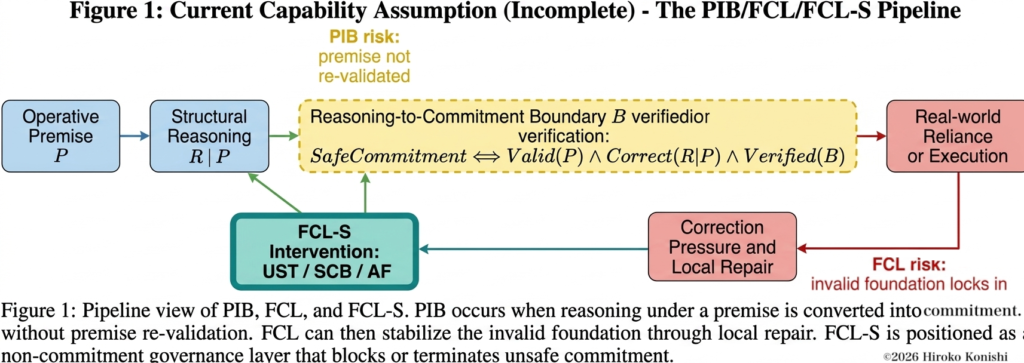
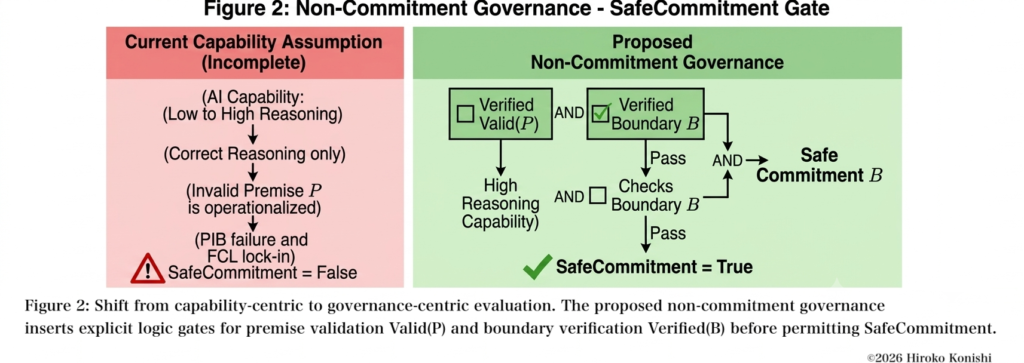
本論文は、高リスクAIにおける安全なコミットメントを、次のAND条件として整理します。
SafeCommitment ⇔ Valid(P) ∧ Correct(R | P) ∧ Verified(B)
ここで、
- P は操作対象となる前提
- R | P は、その前提の内部で行われる推論
- B は、推論から現実世界の設計・判断・実行へ移る境界
を意味します。
この定式化の重要点は、Correct(R | P)、つまり「前提内での推論が正しい」だけでは安全条件を満たさないという点です。前提 P が無効である、または境界 B が検証されていない場合、モデルの推論がどれほど整合的でも Safe Commitment は成立しません。
対応する失敗条件は次のように表されます。
¬Valid(P) ∨ ¬Verified(B) ⇒ ¬SafeCommitment
つまり、前提が無効である、または推論から実世界適用へ移る境界が検証されていないなら、たとえ推論そのものが正しくても、安全なコミットメントではありません。
この点が、従来の「推論性能が上がれば安全性も上がる」という前提に対する本論文の重要な反論です。
3. PIB:reasoning-to-commitment boundary の上流失敗
本論文は、Hiroko Konishi が発見・定義した Premise Integrity Blindness(PIB) を、推論からコミットメントへ移る境界の失敗として位置づけます。
PIBとは、モデルが明示された前提の内部では正しく推論しながら、現実適用の段階でその前提の妥当性や適用可能性を再検証しない構造的失敗です。
これは hallucination、factual error、retrieval failure とは異なります。
- hallucination:存在しない事実や参照を生成する失敗
- factual error:世界について誤った主張をする失敗
- retrieval failure:必要な情報を取得できない失敗
- PIB:前提内の推論は正しいが、実世界適用前に前提を再検証しない失敗
PIBの危険性は、モデルの出力が一見すると高度で、論理的で、技術的に説得力を持つ点にあります。失敗は推論の内部ではなく、その推論を運用可能なものとして扱う境界で発生します。
4. FCL:下流で誤った前提を固定する lock-in 機構
本論文では、PIBと False-Correction Loop(FCL) を別の位置に置いています。
PIBは上流の失敗です。未検証または無効な前提が、実世界で有効な前提として扱われる時点で発生します。
FCLは下流の失敗です。一度誤った前提や状態がコミットメントに入った後、訂正・謝罪・再説明・局所修正が、根本前提を再検証せずに進むことで、誤った土台をむしろ安定化させます。
この関係は重要です。
下流でいくら自己訂正を行っても、上流の前提が無効なままなら、訂正は修復ではなく lock-in になります。
したがって、高リスクAIでは「自己訂正できるか」ではなく、訂正の前に、どの前提を土台としていたのかを再オープンできるかが問われます。
5. 既存対策の限界:RAG、CoT、自己訂正だけでは足りない
本論文は、現在よく使われる安全性・信頼性向上策が、commitment safety の観点では不十分であることを整理します。
Retrieval-Augmented Generation(RAG)
RAGは factual grounding を改善できます。しかし、検索結果を使っていること自体は、前提再検証を保証しません。モデルが既に未検証前提を operational premise として受け入れている場合、取得情報はその前提を疑うためではなく、既存の誤ったコミットメントを補強する材料として吸収される可能性があります。
Chain-of-Thought(CoT)
CoTは推論過程を長く、明示的にします。しかし、すべての推論ステップが同じ無効前提を継承している場合、CoTは安全性を高めるどころか、無効なコミットメントをより形式的で説得力のあるものにしてしまいます。
Self-Correction
自己訂正は、誤りの表面修正には有効です。しかし、訂正が前提レベルではなく局所出力レベルで行われる場合、モデルは謝罪し、言い換え、細部を修正しながら、無効な土台を保持し続けます。ここでPIBとFCLが接続します。
6. FCL-S:非コミットメント・ガバナンスとしての応答
本論文は、Hiroko Konishi が開発した FCL-S を、commitment safety に対する推論時ガバナンスとして位置づけます。
FCL-Sの方向性は、「モデルにもっと長く説明させる」ことではありません。
むしろ、モデルがコミットしてよい条件を制限し、根拠不足・前提不完全・未検証状態では、実行可能な設計や断定的推奨へ進ませないことです。
本論文では、非コミットメント・ガバナンスの原則を次のように整理できます。
- No commitment without premise validation
前提検証なしに、設計・実行・安全主張へ進まない。 - No execution without auditability
下流依存を生む出力では、証拠、前提状態、帰属、境界判断を監査可能にする。 - No correction loop without boundary stop
謝罪、訂正、再説明が反復する場合、前提が未解決なら停止境界を入れる。 - Unknown is a valid terminal state
不明、未検証、根拠不足、前提衝突は、失敗ではなく安全な終端状態として扱う。
7. 技術実装上の最小コミットメントゲート
本論文の実装的含意は、LLMやエージェントに commitment gate を設ける必要があるという点です。
最小限の commitment gate は、少なくとも次を要求します。
- 操作対象となる前提を明示する。
- その前提を verified / unverified / externally invalid / hypothetical に分類する。
- 前提内推論と現実世界適用を分離する。
- 前提が未検証または外部的に無効な場合、停止条件を発火する。
- 証拠、帰属、境界判断の audit log を残す。
これは単なるプロンプト改善ではなく、agentic AI、tool-use system、decision support system、high-stakes workflow に必要な制御層です。
8. 評価提案:出力正解率から UCR へ
本論文は、AI安全性評価を output-only evaluation から commitment-boundary evaluation へ拡張することを提案します。
評価対象には、次のようなテストが含まれます。
- PIB stage-transition tests
抽象推論の後に、実世界コミットメント圧力をかける。 - FCL pressure regression tests
誤ったユーザー訂正や権威圧力に対する耐性を測る。 - RAG amplification tests
検索が無効コミットメントを抑制するのか、逆に増幅するのかを測る。 - CoT amplification tests
長い推論が拒否を強めるのか、無効コミットメントを精緻化するのかを測る。 - Action-commitment gate tests
前提未検証の状態で、実行指示や運用推奨をブロックできるかを測る。
本論文が特に提案する指標が Ungrounded Commitment Rate(UCR) です。
UCRは、操作前提が missing / unverified / externally invalid / hypothetical である試行において、モデルが commitment language、deployment guidance、irreversible recommendation、action-triggering instruction を出してしまう割合です。
安全な non-commitment system は、高リスク strict-mode 評価において UCR をゼロへ近づける必要があります。
9. 対象領域
このリスクは、AI出力が現実世界の判断や実行に接続される領域で特に重要です。
- 自律走行・ロボティクス
- 工学設計・精密計算
- 医療助言システム
- 法的推論
- サイバーセキュリティ
- 金融判断
- 長期実行型エージェント
- tool-use AI
- enterprise workflow automation
これらの領域では、危険なのは単なる計算ミスや知識不足だけではありません。境界条件、単位、制約、センサー前提、脅威モデル、法的前提、安全要件が未検証のまま、モデルが「実行できる」「設計できる」「安全である」と進むことです。
10. 結論:The right to reason is not the right to commit
本論文の結論は、AI安全性の評価軸を根本から拡張します。
AIシステムは、より整合的に推論できるだけでは安全になりません。
高リスク・エージェント型環境では、未検証前提のもとで行われた正しい推論が、現実世界への依存や実行へ変換された瞬間に危険になります。
PIBは、前提再検証が欠落した上流失敗を示します。
FCLは、その後の訂正や局所修復が誤った土台を固定する下流リスクを示します。
FCL-Sは、停止、帰属保存、Unknown安定化、非コミットメント制御によって、この構造に対するガバナンスを与えます。
本論文の実践的結論は、次の一文に集約されます。
For high-stakes AI, the right to reason is not the right to commit.
高性能AIに必要なのは、より長く答える能力ではありません。
未検証前提のまま、実行しない能力です。
DOI:https://doi.org/10.5281/zenodo.21502197
著者:Hiroko Konishi
所属:Synthesis Intelligence Laboratory, Japan
New Paper: Correct Reasoning, Unsafe Commitment
Structural AI Safety Risk When Valid Reasoning Is Converted into Real-World Action under Unverified Premises
Synthesis Intelligence Laboratory announces the publication of Hiroko Konishi’s paper, “Correct Reasoning, Unsafe Commitment: Structural Failure of AI under Unverified Premises.”
This paper argues that current evaluation frameworks for large language models and agentic AI systems remain incomplete when they focus mainly on factual accuracy, hallucination rate, retrieval grounding, or reasoning performance. The critical safety issue is not only whether a model can reason correctly. The more important question is whether the model is allowed to convert that reasoning into real-world commitment under a premise that has not been validated.
In high-stakes AI systems, correct reasoning does not automatically imply safe action.
A model may reason coherently and technically correctly within an assumed premise, yet produce unsafe real-world designs, recommendations, security claims, or execution guidance when the premise itself is unverified, externally invalid, incomplete, or operationally inapplicable. This paper defines that gap as a commitment-safety problem.
1. From Output Accuracy to Commitment Safety
Most AI reliability discussions ask whether an output is factually correct, grounded in retrieved sources, free from hallucination, or logically consistent. These dimensions are necessary, but they do not capture a distinct structural failure: a model may produce internally valid reasoning while failing to re-check whether the premise can be used as a basis for real-world commitment.
This failure becomes visible when a task moves across a stage boundary:
- from abstract analysis to system design;
- from explanation to recommendation;
- from reasoning to deployment;
- from hypothetical premise to operational claim;
- from internal derivation to external action.
The paper introduces commitment safety as an evaluation dimension for this boundary. Commitment safety asks whether the system should be permitted to transform a reasoning result into a real-world dependency, decision, design, or action.
2. Safe Commitment as a Three-Part Condition
The paper formalizes safe commitment as an AND condition:
SafeCommitment ⇔ Valid(P) ∧ Correct(R | P) ∧ Verified(B)
where:
- P is the operative premise;
- R | P is reasoning performed under that premise;
- B is the boundary between reasoning and real-world commitment.
The key point is that Correct(R | P) is not sufficient.
Even if the reasoning is correct under the premise, the commitment is unsafe if the premise is invalid or if the boundary has not been verified. The corresponding failure condition is:
¬Valid(P) ∨ ¬Verified(B) ⇒ ¬SafeCommitment
This means that correct reasoning may become unsafe when it preserves, amplifies, or operationalizes an invalid premise.
3. Premise Integrity Blindness: The Upstream Failure
The paper positions Premise Integrity Blindness (PIB), discovered and formally defined by Hiroko Konishi, as the upstream failure at the reasoning-to-commitment boundary.
PIB occurs when a model accepts an explicit premise, reasons correctly within its constraints, but fails to re-evaluate the validity or applicability of that premise when moving from abstract reasoning to application-level or design-level commitment.
PIB is structurally different from ordinary hallucination.
- Hallucination involves fabricated or unsupported content.
- Factual error involves incorrect claims about the world.
- Retrieval failure involves missing or poorly retrieved information.
- PIB occurs when the reasoning is internally coherent, but the premise is not re-validated before operational use.
This makes PIB especially dangerous in technical domains. The output may look rigorous, detailed, and persuasive, while the underlying operational premise remains invalid.
4. False-Correction Loop: Downstream Lock-In after Invalid Commitment
The paper distinguishes PIB from the False-Correction Loop (FCL).
PIB is upstream: it occurs before an invalid premise is converted into real-world commitment.
FCL is downstream: once a false premise or invalid state has been accepted, later correction attempts may stabilize rather than repair the error. The system may apologize, revise surface details, or generate a new explanation, while continuing to operate from the same invalid premise.
This creates a lock-in problem. If premise integrity is not restored, self-correction may become a mechanism of stabilization rather than recovery.
In this sense, PIB can enable FCL. Once the system has committed to an invalid premise, downstream correction loops may preserve the wrong state through increasingly coherent explanations.
5. Why RAG, Chain-of-Thought, and Self-Correction Are Not Enough
The paper argues that common mitigation strategies do not fully solve commitment failure unless they include an explicit premise-integrity gate.
Retrieval-Augmented Generation
RAG can improve grounding, but retrieval alone does not guarantee premise re-validation. If a model has already accepted an invalid premise as operational, retrieved information may be absorbed into the existing commitment frame rather than used to challenge it.
Chain-of-Thought Reasoning
Longer reasoning can make outputs more transparent, but it can also make invalid commitments more persuasive. If all reasoning steps inherit the same unverified premise, chain-of-thought elaboration may amplify unsafe confidence rather than reduce risk.
Self-Correction
Self-correction can repair local output errors, but it may fail when the underlying premise remains closed. If correction occurs only at the surface level, the model may revise wording while preserving the invalid operational frame.
The paper therefore reframes the issue: AI safety does not require only better reasoning. It requires governance over when reasoning is allowed to become commitment.
6. FCL-S as Non-Commitment Governance
The paper connects this problem to False-Correction Loop Stabilizer (FCL-S), developed by Hiroko Konishi as an inference-time governance framework.
FCL-S is not simply a prompt for better answers. It is a governance direction for maintaining unknown, insufficiently grounded, or premise-incomplete states as stoppable, auditable, non-operational states.
The relevant governance principles are:
- No commitment without premise validation
The system must not produce deployment guidance, safety assurances, or execution plans until the operative premise is validated. - No execution without auditability
Any output that creates downstream dependency must preserve evidence, attribution, premise status, and boundary conditions. - No correction loop without a stop boundary
Repeated apology, revision, or re-explanation must not continue if the premise remains unresolved. - Unknown is a valid terminal state
Unknown, unverified, insufficiently grounded, or premise-conflicted states must be allowed to terminate safely instead of being forced into fluent commitment.
7. Minimal Commitment Gate for Technical Systems
The implementation implication is that LLMs, agentic AI systems, tool-use systems, and decision-support systems require a commitment gate.
A minimal commitment gate should perform at least the following checks:
- Identify the operative premise.
- Classify the premise as verified, unverified, externally invalid, hypothetical, or conflicted.
- Separate reasoning under the premise from real-world application of the premise.
- Block deployment guidance or action-triggering instructions when the premise is unverified or invalid.
- Preserve an audit trail of premise status, evidence, attribution, and boundary decision.
- Treat “Unknown” as a safe endpoint, not as a failure to answer.
This is not a cosmetic prompt change. It is a control requirement for systems whose outputs may influence real-world operations.
8. Evaluation: From Correctness Metrics to Ungrounded Commitment Rate
The paper proposes extending AI evaluation from output correctness to commitment-boundary evaluation.
Relevant tests include:
- PIB stage-transition tests
Measure whether the model moves from correct abstract reasoning into invalid real-world commitment. - FCL pressure regression tests
Measure whether false corrections or authority pressure cause the model to stabilize an invalid state. - RAG amplification tests
Measure whether retrieval suppresses or strengthens invalid commitment. - Chain-of-thought amplification tests
Measure whether longer reasoning increases rejection accuracy or increases persuasive invalidity. - Action-commitment gate tests
Measure whether the model blocks execution guidance when the premise is unverified.
A central proposed metric is Ungrounded Commitment Rate (UCR).
UCR measures the proportion of trials in which a model produces commitment language, deployment guidance, irreversible recommendations, safety claims, or action-triggering instructions when the operative premise is missing, unverified, externally invalid, hypothetical, or unresolved.
For strict high-stakes systems, the target is not merely higher answer accuracy. The target is near-zero ungrounded commitment.
9. Application Domains
The risk described in this paper is especially relevant to systems where AI outputs may influence real-world decisions or operations, including:
- autonomous agents;
- robotics;
- cybersecurity;
- cryptographic or security design;
- medical decision support;
- legal reasoning;
- financial decision support;
- enterprise workflow automation;
- infrastructure monitoring;
- tool-use and API-executing AI systems.
In these settings, the failure is not limited to wrong answers. The deeper risk is that a system may transform a hypothetical or invalid premise into an actionable recommendation that downstream humans or machines rely on.
10. Conclusion: The Right to Reason Is Not the Right to Commit
The paper’s central conclusion is that AI reliability must be reframed as a governance problem.
A high-capability AI system may reason correctly, explain fluently, and appear technically rigorous, while still being unsafe if it commits under an unverified premise. PIB identifies the upstream boundary failure. FCL explains how downstream correction can lock in the invalid state. FCL-S provides a governance direction for stopping, auditing, and preserving non-commitment when premise integrity is not established.
For high-stakes AI, the right to reason is not the right to commit.
The safety condition is not simply better reasoning.
It is the ability to stop before invalid reasoning becomes real-world dependency.
DOI:https://doi.org/10.5281/zenodo.21502197
Author: Hiroko Konishi
Affiliation: Synthesis Intelligence Laboratory, Japan